
Showing posts with label champagne. Show all posts
Showing posts with label champagne. Show all posts
Friday, October 28, 2011
The Champagne Diet
Once again, I'm on some sort of diet. "Don't call it a 'diet'," my in-shape friend said, cramming another chicken wing into his gaping maw, pieces of poultry flotsam flecking my anemic plate of vegetables. "It's 'eating right'."
Have another wing, you rabbit-metabolism SOB.
But, he's right. I can't call eating better a diet. It really is a matter of making better choices, and doing them regularly; not as a quick fix.
And usually, "eating right" consists of cutting out all the things a Southerner with Irish roots who loves Italian food thrives upon: fried vittles, pork fat, pasta, bread, cheese, potatoes, and...
Alcoholic beverages. Beer and wine. The good stuff, packed with calories. Diet cola and Bacardi rum are given no quarter in my household, and the combination of the two is about as appealing as Lindsay Lohan + Playboy ("hey mac, don't forget to airbrush out the crack pipe and 99¢ Jack-in-the-Box tacos").
Therein lies the rub. Tomorrow (well, today) is International #ChampagneDay. Wine lovers around the world will pop corks and celebrate the hallowed home of sparkling wine. Then, they'll get on Twitter to discuss, share, and enjoy with hundreds of others in the nerdiest way possible: on Twitter; marking their tweets with the 'hashtag' #ChampagneDay, creating a searchable, consistent thread connecting all the myraid conversation.
But, despite the ribbing, these Twitter tastings do create a community around a common theme: drinking, then posting regrettable comments online. It's the American way!
Never being one to thumb my nose at America, I think I'll be taking a temporary break from carbohydrate purgatory to indulge in perhaps my favorite beverage. Maybe this one?

Schramsberg furthermore makes all it's wines in the "traditional method" (or Méthode Champenoise, if you don't mind irking at least one Frenchman). Basically, this means that the grape juice is fermented into a still (non-sparkling) wine, and then added to the bottle with a mixture of yeast and some sugar, creating a second fermentation in the bottle, resulting in the fizz. This is the most classical (and most expensive) way to make a sparkling wine, and it results in a product of superior quality, taste, and complexity.
Alas, if I were to consume the jewel of Napa's sparkling crown, I would not be properly celebrating Champagne. See, Champagne is a region of France, to the East-Northeast of Paris. The name "Champagne", although so often used to describe a style of wine (and Champagne and other sparklers are most certainly wine), technically has nothing to do with the fact that the wine has bubbles.
Wines from Champagne are called "Champagne" because it is believed they express the place itself. The French call the concept terroir. Certain specific places have the climate, the soil, the orientation to the sun, the... je ne sais quoi to create great wine, and those very places are felt to be much more important than the grapes themselves.
In the States, we've been conditioned to buy wine based on the grape variety on the label. Not a problem, but it has rendered the concept of terroir difficult to us. However, just like "San Francisco Sourdough" from Albuquerque is not really San Francisco Sourdough, sparkling wines from anywhere other than Champagne, France, are not "Champagne".

Granted, some readers may know me as a bit of a Champagne-elitist, avoiding the heavily marketed stuff in favor of lesser-known "farmer fizz". While true, I've also been known to wear wolf shirts. And anyone who runs with the wolf shirt pack is most likely an indiscriminate drinker. Like this guy:
 |
| (photo credit: kotaku.com) |
As am I. In my wolf shirt. With bottle in hand. Wanna fight about it?
Sorry, sorry. That was the wolf shirt talking. I love you all, and hope you'll pop a bottle as well tomorrow (today). Happy #ChampagneDay!

Tuesday, June 28, 2011
Avoidably Detained

It's not that I don't love you, I just love Champagne more. Or, should I say, I love to pop some bottles for good friends.
Off a roughly-seven month run consisting of kids' birthdays, family events, weddings, and the miscellany consuming the life of a thirty-something suburbanite, the past weekend seemed an appropriate time to slow down and enjoy. Fun and food with good neighbors, some splashing around and hopefully-not-pooping-in-it pool time with the li'l critter, and general relaxation. Rather, relaxation that has been a leprechaun riding a unicorn. That is to say, rare (but surprisingly easy to find online).
So, while the blog is peppered with occasional posts in which I feebly gripe about being too busy to write, I've penned this one to say I haven't posted in 5 days because I desired to get off the grid. Take some time to enjoy the blessings that have surround me. You know, at least for a couple days.
Funny how we can get so caught up in studying wine, discussing wine, analyzing wine, and arguing about it. The past weekend has served as a good reminder that our beloved beverage works its most-brilliant wonders when it is simply enjoyed in the company of friends...
...and I was talking about the kid pooping in the pool, not me. But I can see how that would throw some folks.
Tuesday, May 10, 2011
Bubbles alone do not a Champagne make.

Looking at the title of this post, my grammar has devolved to Yoda-esque sentence structure. Perhaps I'm quickly becoming a shriveled wine curmudgeon, relegated to cryptic tidbits on the fermented grape, designed to put frustrated winos on the path to righteousness.
Or, maybe there's wisdom in the header; a critical piece of knowledge that fledgling wine-Jedis must heed in order to restore balance to the vinous Force...
Probably the former, but bear with me here, because what I'm about to say is very important:
NOT ALL SPARKLING WINE IS CHAMPAGNE.
Please, repeat this statement again, as I didn't hear you the first time with this ridiculous Yoda hat covering my ears.
NOT ALL SPARKLING WINE IS CHAMPAGNE.
One more time, because I can hear someone out there calling a bottle of Tott's Brut "Champagne", and my blood is about to boil (cementing the preceding suspicion that I have- indeed- become a wine curmudgeon).
NOT ALL SPARKLING WINE IS CHAMPAGNE.
I really need to quit being a jerk about it and put some explanation behind the mantra, because we've probably all been conditioned to think otherwise. "Champagne" is not necessarily a style of wine. However, it is a wine. A French sparkling wine from the region of Champagne, to be more specific.

The French- generally speaking- are really hung up on sense of place. They feel that a wine should speak to where it comes from: the vine configuration, the soil composition, the slope upon which it is planted, the orientation towards the sun, the climate, and the surrounding geography and geology. For the French, this terroir (basically translating to all that stuff I described) is what one should smell, taste, and feel when enveloped by a great wine, so much more so than the grape from which it is made. To this end, the wines of France have traditionally been labeled by places, rather than by grape varieties. Bordeaux is a region, not a grape or necessarily a style. Burgundy is a region. Champagne- not so coincidentally- is also a region.

Situated in the northeastern part of Gaul (I'm scratching for synonyms for "France" at this point), the Champagne-Ardenne region is subjected to a rather cool climate, producing grapes (mainly Chardonnay, Pinot Noir, and Pinot Meunier) with lower sugar levels and higher acidity. These grapes produce wines of extraordinary freshness, and the addition of bubbles only amplifies the palate-cleansing sensation of Champagne. And how do those bubbles get there? A secondary fermentation in the sealed bottles create yeasts' two primary byproducts- alcohol and carbon dioxide. The latter contributes to the fizz. Check this out if you want to learn more about production methods (there are several), as I have trouble keeping it brief.
Any other sparklers not produced in the Champagne region of France are simply not "Champagne". Disagree? Tough shit. Blame terroir.

That being said (quite crudely, for emphasis and questionable comedic value), some would want to fool you. Many California producers (Korbel, Cook's, and formerly Paul Masson, for example) listed "Champagne" on the bottles for years. The French sought to protect the name, and made treaties a few decades ago to only allow bottles from Champagne to be labeled "Champagne". However, a deal was struck to allow a few producers in California to keep the name, as long as bottles were labeled as "California Champagne". Confusing, ridiculous, and perpetuating the cryptic nature of wine in general, in this guy's opinion.
Despite not leveraging the marketing clout of some famous dirt, there are many excellent sparkling wines produced outside of Champagne that are worth a try. This is especially true when considering that the real stuff usually fetches a pretty hefty price, thanks mostly to marketing and rap videos. But lets say you're name isn't Skee Lo, and you just want a mimosa to get your Tuesday morning started. Surely something more affordable is out there:

Crémants: French sparkling wines made outside of Champagne are called "Crémant de [region]". So a bubbler from Burgundy would be Crémant de Bourgogne, from the Loire would be Crémant de Loire, and Alsace would be Crémant d'Alsace, and so on. They are all generally made in the "Champagne method" (secondary fermentation in the bottle), and offer good value and interesting flavor profiles, as all are made from the allowable grapes of their respective regions. Also sometimes called Mousseux.
Cava: the sparkling wine of Spain is generally made from the Parellada, Macabeo, and Xarel-lo grapes (and increasingly, Chardonnay). They are also made in the traditional method (aka "Champagne Method"), and offer ridiculous value, usually going off shelves for under $10.
Prosecco: an inexpensive and pleasing Italian sparkler, made from the Glera grape.
Sekt: German bubbly, often made in the Charmat method, meaning secondary fermentation occurs in large stainless-steel tanks, and then that wine is bottled under pressure to keep the bubbles from escaping.
Cap Classique: South African sparklers made in the traditional method.
American Sparkling Wine: avoid the cheap stuff (think college headaches) and search for producers who make quality wines in the traditional method. Some easy-to-find bottlings include Domaine Carneros, Domaine Chandon, Gloria-Ferrer, Gruet (from New Mexico!), Iron Horse, J Vineyards, Piper-Sonoma, Roederer Estate, Scharffenberger, and Schramsberg (among others). Many are owned by French Champagne houses, so they try to keep with the same level of quality.
...
...glad I got that off my chest. I don't mean to get feisty about it. Sometimes, there's just an ax to grind.
Or maybe it's a lightsaber.
Thursday, April 7, 2011
Inside Jokes.
So, I spent about 3 hours (when I should have been writing) working on this tonight:

Why? Because I read a hilarious account of a day in the life of a wine retailer (followed by a very important lesson for EVERYONE who likes to drink wine) over at Samantha Sans Dosage today. If you haven't read her blog, Samantha is a brilliant writer and knows a whole lot about wine. If you had to choose between this blog and hers, I'm out of a job...
...and a poor-paying job, at that.
Tuesday, February 22, 2011
Now hang on one hot minute.

Last week, I jabbed a thumb in the eye of wine-tasting protocol, using a popular technique of the insecure: sarcasm. It was a joke. In all seriousness, I adore when the person next to me at a tasting gives me the business for not picking up the delicate hints of porpoise dander in the Wild Irish Rose we're sipping...


...wait, was that sarcasm? It doesn't translate well in print, does it?
Anyway, I was having some fun with embellishment on many things I'd heard at tastings. The vast majority of ridiculous statements at wine tastings involve proclamations of unbelievably obscure smells and tastes. However, despite my snark, I honestly believe there can be tremendous value in learning telltale aromas and flavors in wine, as well as probing for new ones.
Cool out! Let me explain this perceived one-eighty.
There's nothing wrong with a frame-of-reference. I strongly subscribe to the notion that a better understanding of a recreational activity makes it far more enjoyable, whether that be watching a hockey game, smoking a brisket, or shooting pool against a guy whose first name is "Detroit". You ain't winning against a guy named "Detroit". I bet he brought his own two-piece pool cue to the table, didn't he? But you didn't have a keen understanding of that. And now you are broke, and likely wounded by knife.
But back to my point. Part of the fun of wine is being able to stick you nose in it and smell apples, chocolate, green pepper, etc. Science has often lauded the strength of olfactory memory, so tasters already have brains full of familiar smells. It's always fun to pick one of those out when sniffing a glass. Case in point: my friend, absurdly talented writer, and professional wine slinger Samantha (of The Wine Country in Long Beach, CA) recently got me on the fast-track to debt by introducing me to "grower" Champagne. These bottlings feature grapes both grown (thus the name) and bottled by the producer, something rare among the big Champagne houses, who usually buy their grapes from other growers to produce their Veuve Clicquots and Dom Perignons. Grower certainly isn't cheap, but can really bring some value if you're looking for incredibly complex flavors and aromas in your everyday $60-80 bottle of sparkling wine (see previous comment about imminent debt).
The last bottle I had was a 2004 Marcel Moineaux Grand Cru Blanc de Blancs. 100% Chardonnay ("blanc de blancs" tells you that), and darn tasty. But here's why I bring this whole mess up: that stinkin' wine smelled exactly, EXACTLY like hot, fresh Krispy Kreme donuts. In an instant, some stupid little glass of wine transported me back to Saturdays as a kid. After playing rec basketball games at Roswell, Georgia's Waller Park- nothing more than a rusty shed with some hoops on the walls at the time- the old man would often take my brother and I by the Krispy Kreme on the corner to pick up a revitalizing post-game donut. At this point, the Champagne had become more; I wasn't just drinking an alcoholic beverage. I was triggering a strong olfactory memory that added tremendously to the experience. Pretty cool, huh? Of course, then the smell further triggered memories of how bad I was at basketball, and I got depressed. At that point, the alcohol was ready to serve its needed purpose.

Similarly, having familiar olfactory reference points can enhance the enjoyment of wine. Like I said earlier: having a better understanding of something will often improve the interactive experience. However, the operative word here is "familiar", and that's where I have my big ol' bugaboo. When I hear someone say "organic tangerine blossoms" instead of "citrus"; "overripe peels of fuji apple" instead of "apple"; "petrol" instead of "gasoline" (at least in the States); "Japanese violet" instead of "floral"; "yearling antelope droppings" instead of "poop"... man, I tend to get a little irritated. Yes, there is a tiny percentage of the wine-drinking population that has trained its palate to such sensitivity that differences in types of specific fruit, spice, etc. are perceptible. They're downright freaks of nature. However, for 99% of the population, more general descriptors will not only assist in recognizing flavors in aromas, but will also not alienate novices and make them feel inferior. I'm convinced that most of that obscure, overly-descriptive blather is designed to elevate said blatherers' senses of themselves, while simultaneously causing doubt and confusion among less-pretentious tasters. In more clear terms, those people are irritating assholes.
Here's the takeaway: wine education and sensory frames-of-reference are good, and they can help everyone heighten enjoyment of an incredible beverage. Even very advanced descriptors can be helpful, as long as they are honest (not contrived or regurgitated from a wine publication) and meant only to improve the experience for all...
Of course, maybe you never got to eat a Krispy Kreme donut as a kid. Does that make me an asshole? Probably.
Friday, August 20, 2010
Booze in the News - 8/20/2010

Two weeks in a row. You impressed yet?

A Bridge Too Long: National and State government in Germany's Mosel (a very famous wine-producing area, known for world-class Riesling) is going ahead with a project to build a bridge spanning the region. The idea is to relieve congestion and increase tourism in the area. The detractors of this project, known as the "Pro-Mosel" group, are fighting the potential eyesore, as it will take away from the Mosel's scenic beauty. Yep, leave it to the Germans to take something pure and wonderful and screw it up. Remember how music used to be cool? I'm blaming all this auto-tuned crap on the Düsseldorf-based band that put robotic lyrics on the map. For shame, Kraftwerk. Who knew "Electric Café" would cause so much collateral damage?

Bursting their Bubbles: As humiliating to France as André the Giant getting bodyslammed at WrestleMania 3 by the Hulkster, new science has proven that the hallowed and traditional technique of pouring Champagne directly into a vertical flute is flawed. The loss of dissolved carbon dioxide has been scientifically-proven by physics geeks to be lessened by pouring the wine at an angle, à la the way you'd pour a beer into a tall, tilted glass to retain some head. Even more shocking is how little I care about this research. Besides, everyone knows the best way to pour Champagne is to cut out the middle-man and employ the direct "bottle-to-lips" method, resulting in the most-efficient manifestation of what scientists call "fizzy goodness in the tummy" syndrome.

Warm Springs, indeed: It's a well-known fact (especially to residents of Georgia) that Franklin Delano Roosevelt spent a good deal of time in Warm Springs, GA, taking advantage of the natural hot springs to soothe his polio-riddled body. However, an NPR Planet Money podcast revealed that the rejuvenating waters of west-central Georgia were a secondary draw for the soon-to-be 32nd President. His first love: "stump juice", aka, moonshine. Yep, FDR was supposedly sucking down white lightning- during Prohibition, no less- while away from Hyde Park. Personally, I speculate that his love of Peach State mountain dew (let's see how many 'shine synonyms I can fit in here) led to his push to repeal Prohibition. I'm going to go ahead and fully credit illegal Georgia booze with sound Presidential decision. In fact, I'm working on acquiring a case to send to 1600 Pennsylvania Avenue immediately.
Friday, June 4, 2010
Classic Pairings 201: Oysters and Bubbles
I found myself wistfully gazing back on yesteryear earlier today (which, oddly, wouldn't be referred to as "yesterday"...hmmm...yestertoday?). And as yesteryear manifested itself yestertoday in my mind, I reminisced on the good ol' days, otherwise known as "yesteryear", or at least that's what they were called yestertoday. Things may have changed by now...

Ah, I was so young and foolish back then, full of hope and impossible dreams...
...childhood? No, I'm talking about January. The false hope of New Year's resolutions had me thinking I would stick to a routine; a schedule of regularly-themed posts, offering you- the reader- a consistent and predictable humor/education, nay, edu-tainment experience. For example, one such pipe dream included classic pairings every Wednesday. Remember these delights?
Classic Pairings 103: Syrah-lence of the Lamb
All completed in January. JAN-YOO-AIR-EEE. It's June. Aren't there more than 3 pairings out there? Why have I let you down??
My best excuse is that cooking for a pregnant wife not only limits the food you can prepare, but severely cripples the efforts by the household to drink a bottle of wine, thus damaging the odds of opening a bottle in the first place, as said bottle is now more vulnerable to waste and spoilage. It's a terrible excuse, I know, but I've got to plead some sort of pathetic case here.
Now you- the attractive and astute readership- have no time for my alibis, and frankly, you're probably tired of me talking about babies. So, with that directive in mind, I concocted perhaps my favorite "classic" pairing on earth.

Oysters and bubbly (in this case, Champagne) might be the finest set of bedfellows since, well, since the last time someone used the word "bedfellows" in the modern written word. Granted, Champagne and much sparkling wine is notorious for being a fast-friend with food (due to high acid, freshness, and the palate-cleansing virtue of fizz). However, for some reason, I can't think about anything else to even compare with some oysters. Yeah, that includes beer. I don't believe I'm even saying this. But dammit, with all due respect to beer, IT'S THE TRUTH. I'd bet my crappy plating abilities on it.

In the case of this particular post, the oyster employed was Long Island's famed Blue Point. While much of my experience (being from Georgia) is with either Apalachicola Oysters or Gulf Oysters, I went with the Blue Points because, well, that's all that they had. And I suspect that I won't be getting any Gulf Oysters anytime soon. I bite my thumb at you, BP.
Anyway, I decided to toss these beauties on the grill for a few minutes, rather than eat them raw. The latter is usually the most common form of consumption (which I enjoy), but something about heating these up just until the briny juices within them bubble and the shells pop open, allowing some of the smoke from the fire to permeate the meat...[Homer drooling noises]. And yes, it is that simple. Put the oysters on the grill. When the shells open (after 4-8 minutes), dinner is served. If they don't open, don't eat 'em. They skip across ponds quite nicely in that case.

For the bubbles, I ended up with a half bottle (375 ml) of Laurent-Perrier NV Brut L-P Champagne. The "NV" stands for "non vintage", and what that means is that the final product in my bottle is a combination of wine from possibly several different years. This is done so that the producer can create a consistent flavor profile for the wine year-after-year (known in Champagne as the "house style"). Since the inconsistent weather patterns vary season-to-season, sometimes the blending needs to be tweaked to maintain the house style. Master blenders- aka "folks much more talented than me"- undertake the painstaking task of tasting samples from many different barrels of wine from the respective year, as well as previous years. Furthermore, they taste Pinot Noirs and Chardonnays and Pinot Meuniers (the three allowable grapes in the Champagne AOC). This process is known as assemblage, and I bet I would suck at it.
Laurent-Perrier's "house style" is lighter than many other Champagnes, much of that perhaps due to the fact that they use mostly Chardonnay. I chose the lighter-styled sparkler because I think it worked great with the delicate brininess of the oysters. And the blue-blooded blue point oysters seemed to be more delicate and briny than the blue-collared gulf oysters I usually find fried in my po boy. The mineral elements in the wine- likely attributed to the chalky soils of Champagne- offered a perfect complement to the salinity of the juice, the almost-metallic flavors within the oyster meat, and the likewise minerality lent to the oyster and the juice by the shell. Furthermore, the citrusy components and the acidity of this light-bodied blubbly worked like a spritz of lemon...never a bad move on an oyster, or any seafood for that matter.
So, the richness, the acid, the minerality, the brininess...the luxurious combination of delicate seafood and delicate mousse of fizzy Champagne (or California sparkling, or Spanish Cava); all these elements working in harmony confirm why this is such a classic pairing. If you haven't tried it before, I suggest you do so this weekend. Especially if you plan on eating outside in the sultry summer (well, almost summer) evening. There just isn't much better.
And if you're looking for another food-and-wine marriage, join me here next year when I discuss classic pairings 202!
Monday, May 31, 2010
Our little bundle of joy has arrived!

 Finally, after months of anticipation, our very special delivery has arrived! We're so happy that she's finally here, and we know that she'll make a perfect addition to the family...
Alright, I suppose I could've titled this post "a textbook case of crying wolf". No, the kid's not here, but she's very close (maybe this week). For that reason, it's been a whirlwind the past couple weeks to get everything put together, creating a proper environment for our new arrival (and, as much as I feel we'll never get the house quite right, a Monday marathon of "Hoarders" has set my mind at ease that we're in better shape than we think).
Of course, as part of the welcome-wagon preparation, a proper bottle of Champagne has been deemed crucial to the celebration. While I talked a big game a while back about Jeroboams and such, the winner ended up being a magnum of Heidsieck & Co. Monopole Blue Top Champagne NV. Not necessarily my first choice, but I'm confident it will be darn good. Yeah, I know it's a blue top for a girl, but forgive me if I refuse to bow to your gender stereotypes. I'm progressive, alright??
As far as going with the magnum over the double-magnum (aka "Jeroboam"), practicality forced my hand. Here's the thought process:
1) Finding a double mag was damn near impossible (more on that later)
2) a 1.5 liter bottle will yield about 12 glasses of Champagne. Let's be honest: do the wife and I really want more than 12 people in hospital room with our sleep-deprived shells of humanity?
3) referring to #2, I suppose we could drink more than one glass, but I feel like the hospital's a bad place to be drunk, unless there's half a beer bottle sticking out of my head and there are no newborn babies to speak of.

Now, on the issue of the brand (knowing I wanted a bigger bottle), I was really surprised at the limited offering in large formats. Sure, I found Veuve Clicquot (overrated?), Dom Perignon (too expensive. Overrated too?), and some lower-end bubbly. I saw a bottle of Bollinger in a magnum, but it was far-too "James Bond" for a little girl. In the end, I really have to tip my cap to Anthony at The Vineyard Wine Market in Atlanta. He worked with his distributors to give me some options, and we ultimately landed on the Heidsieck. I'm ultimately very pleased, and I'm confident the bottle will serve as a terrific celebratory gesture to our (and our daughter's) big day.
Sunday, April 18, 2010
Jer[oboam] was a Bullfrog

Now I'm sitting here, thinking, "this is a really stupid name for a post." But, I suppose I'm stuck with it.
Anyway, after spending a fun-filled weekend in birthing and labor classes, I can't help but focus on the impending arrival of my baby daughter. More specifically, the celebration associated. Not surprisingly, I feel toasting with a proper bottle of Champagne or sparkling wine seems quite appropriate. My problem is always doing something with restraint, or at least on the level of normal human beings. I want to celebrate BIG. I want to completely leapfrog everyone else when it comes to the scale of jubilation.
"Leapfrog"...bang! Frog reference realized. Must've been those pork chops I ate for dinner last night. Don't let those wily Fish Industry marketeers fool you: pork is the REAL brain food.

Okay, so I'm gonna welcome my daughter into the world in a big way, and there seems to be nothing better than a giant bottle of bubbly. Luckily, the Champenoise have a knack for such an opus. In fact, one can find sparkling wine in a literal plethora of sizes. "Jefe, would you say I have a plethora of Champagne bottles?" Yes, El Guapo, and here they are:
Split: 1/4 bottle, or .187 liters
Demi: 1/2 bottle, or .375 liters
Standard: 1 standard 750 ml or 3/4 liter bottle (known in liquor as a "fifth")*
Magnum: 2 standard bottles, or 1.5 liters
Jeroboam: 4 standard bottles, or 3 liters
Rehoboam: 6 standard bottles, or 4.5 liters
Methuselah: 8 standard bottles, or 6 liters
Salmanazar: 12 standard bottles, or 9 liters
Balthazar: 16 standard bottles, or 12 liters
Nebuchadnezzar: 20 standard bottles, or 15 liters
*ever wondered why it's called a "fifth"? Me too. 750 ml is actually about 1/5 of a U.S. gallon. Quiz a hobo the next he asks you for a fifth. If he gets it right, he gets the booze, and a little education.

**funny side-note. When I was memorizing these bottle sizes during my CSW certification, someone suggested the following mnemonic to remember the bottles larger than a standard: Magnum, Jeroboam, Rehoboam, Methuselah, Salmanazar, Balthazar, Nebuchadnezzar = MJRMSBN = "Michael Jackson Really Makes Small Boys Nervous". I know, it's terrible, and it doesn't really apply anymore, but not matter what I do, I always run it through my head to remember the bottles. Damn mnemonics!

While I can't say for sure why these wines are put in all these different bottle sizes (other still wines are put in larger bottles too), I suspect it has something to do with presentation. I've heard some say that the wines age better in larger bottles, but I also think that people have always relished the novelty of showing up with a giant bottle of wine at a celebration. It's like being a prop comic. Imagine being the Gallagher of the wine party? It'd be totally awesome, except for the Gallagher part.
In Champagne production (or any bottle labeled "méthode champenoise", "traditional method", "cap classique", or any variation/translation of those), a secondary fermentation occurs in the bottle to create the fizz. However, in some of these huge bottle sizes, such a process is a little unwieldy. Therefore, the wine undergoes secondary fermentation in standard bottles, and then they are emptied into a pressurized tank, treated with dosage, and the wine is loaded into the crazy Gallagher bottles. This process is known as transvasage. Half bottles, standard sizes, magnums, and jeroboams require secondary fermentation in the bottle; transvasage is not allowed.
And so, I'm on the lookout for one of these "large formats" (as the geeks call them). Champagne and sparkling wine are all about celebration, and I can't think of a better occasion. Either that, or I just want to relate with my baby child, thus the need for nursing from a bottle. While I'm leaning towards a bottle of Taittinger (one of my favorites), I'm open to any recommendations any of you may have!
Monday, January 4, 2010
Greeting 2010 with a massive headache
The pregnant wife. The neighbors with kids. The tight budget. The need for sleep.
All a recipe for a quiet evening on New Year's Eve. Maybe a sip of Champagne, a kiss at midnight, and in the bed soon after.

Okay...harmless enough. Started the evening with dessert: a Murphy's Irish Stout float, with a scoop of vanila ice cream dropped into the murky delight. I'd seen this in the past, on the menu at a local pub (The Grange Public House), and most recently HERE on Dale Cruse's tidy Boston Wine/Food/What-Have-You blog, Drinks Are On Me. I challenged the notion of ruining a perfectly good stout with ice cream, but at prodding from multiple sources, I went for it. The verdict? Didn't like it, but not for the reason you may think. I can totally see the appeal. But, if you have a colorful history of college nights soaked with Irish Car Bombs, this tastes exactly like sipping something that you're predisposed to slamming down your gullet as quickly as possible. If you haven't burnt yourself out on the boilermaker of the green-eyed and red-bearded, then you will probably be all over this. I'd like to try it again with a chocolate or oatmeal stout.
No big deal. One drink. I'll be up at 6 AM doing jumping jacks-
-phone rings. "C'mon over! Casino games," say the neighbors. Okay, maybe 7 AM jumping jacks.


First bottle: Charles D'Embrun Champagne Brut NV. I was a little wary. Never heard of it. The bottle was going out of its way to tell me it was "Champagne." Priced too-reasonably at $25.99. Certainly nothing to sneeze at, but pretty darn cheap for real French Champagne. Too cheap? The big names: the Roederers, the Taittingers, the Möet et Chandons, the Bollingers, et al start more around $40. And while I usually prescribe to the notion of "paying for what you get," a little gremlin always tells me that this is going to be the diamond in the rough.
Not quite. While the nose had nice biscuity, yeasty, and lemon-y smells (the former two a product of the wine being aged on the lees, or dead yeast cells in the bottle), the bubbles were very large (I swear larger than my wife's glass of sparkling cider). This is a sign of low quality. Furthermore, in the mouth, it went dead...no finish. Some quick flavors, and then POOF! Gone. Easily, a textbook example of a short finish. Overall, not terrible, but (why didn't I go with my instinct?) "you pay for what you get." Paying $26 and getting "meh" was disappointing.

Getting loopy. Next bottle: Arthur Metz Crémant D'Alsace Brut Millésime 2007. "Crémant" is a term used in France for any sparkling wine not made in the Champagne region (you may sometimes see "Mousseux" instead of "Crémant"). In this case "D'Alsace" would mean "from the Alsace region". This 100% Pinot Noir rosé offered just a faceful of strawberries and cherries, with a nice fizz and dry finish. No yeasty and biscuity flavors, but at $14.99, a pretty good deal. This would make a dang good chaser for a pork BBQ sammich. Chaser for another bottle of bubbly? Trouble brewing...
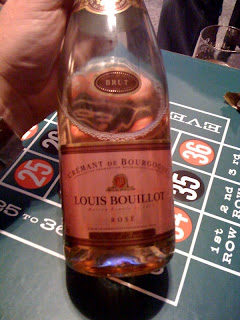
By the time we got to bubbly bottle 3 (there was some still wines mixed in somewhere), clarity of mind was touch-and-go, at best. However, we were eager to compare the crémant of Alsace versus the Louis Bouillot Crémant de Bourgogne (Burgundy) Brut Rosé. This one, likely Pinot Noir, Chardonnay, and (maybe) Aligoté was a full-on slap to the face. It smelled (confirmed by 3 others) exactly, I mean EXACTLY, like an old tent. As if you hadn't been camping in a while, and unfurled the tent and the sleeping bags in the garage. Sadly, although we were amused by the sheer familiarity of the scent, I'd have to say this one was clearly corked (learn more about that in this post). A shame, but at this point in the evening, I'm pretty sure it was consumed anyway...
...I say "pretty sure", because I vaguely recall curling up on the floor shortly after, dreaming hazy dreams of a prosperous 2010, and contemplating the unlikely prospect of those morning jumping jacks.
Happy New Year, everyone.
Thursday, December 31, 2009
Sparkling Wine Tips (in a language I can understand...cartoons)
It's the last post of the year, so I figured I'd blow it out with some cartoons and a showcase of my incredibly sub-par musical skills. Been thinking about doing more of this. If you want more, please oink. If not, hiss like a garden snake.
Whether oinkin' or hissin', I hope all of you have a very safe and Happy New Year! See you in 2010 (if I'm not killed by a flying cork)!
Oh, and Cheers, Sláinte, L'Chaim, Salud, Prost, Skål, Konbe, Kampai, and Laissez les bon temps rouler!
Subscribe to:
Posts (Atom)


