
Showing posts with label sparkling wine. Show all posts
Showing posts with label sparkling wine. Show all posts
Sunday, April 1, 2012
The Best Wine for the Moment
I'm a snob. Particularly when it comes to sparkling wine.
Not much of a secret, really. I write ranting posts like this one. I've yelled at family members. Things like, "it's not Champagne, dammit!" have burst from my lips... words before thoughts, it seems. Never do I intend to come off like a pretentious jerk-ass. It's sort of a bubbly version of Tourette's.
Furthermore, I find myself- inadvertently- turning my nose at most big California producers. For no good reason. I guess I just want to put my dollars towards something obscure, with little financial backing or marketing. Maybe I'm just cheering for the underdog. The small market team.
To summarize, when it comes to bubbly, I have no verbal filter, and an animosity towards capitalism. Guess that makes me the sparkling wine equivalent of Steve Heimoff talking politics on Facebook.
So, why did I find myself purchasing, opening, and drinking this bottle on Saturday?

Domaine Chandon is a Napa Valley-based (Yountville) sparkling wine producer owned by Champagne giant Moët & Chandon. They produce nice, serviceable sparkling wines that retail around $15-20. That is to say, wines that- due to my hubris- I tend to avoid like half-priced sushi.
But sometimes, the bottles we would normally never choose are the absolutely perfect selections for the occasion. My wife and I drank this Saturday morning in some mimosas (sans the orange juice) to kick off our five year anniversary. Chandon was one of the wineries we visited on our honeymoon in Napa. The pink-tinged bubbly, a Blanc de Noirs (meaning "white from blacks", indicating it's a wine made entirely from "black" grapes: Pinot Noir and Pinot Meunier), was rich, satisfying, and a spectacular way to remind us of the joy of the simpler times. Back then, we didn't carry the obligations we carry now, and I certainly didn't give nearly as much a damn about what we were drinking.
At that particular moment in time, there was no wine more appropriate than a Domaine Chandon Blanc de Noirs. It will always share an emotional connection with me. Basking in the afterglow on a pleasant April evening in the Napa Valley, I sipped with my new best friend for life... completely oblivious to how much of a snob I would become.

Tuesday, May 10, 2011
Bubbles alone do not a Champagne make.

Looking at the title of this post, my grammar has devolved to Yoda-esque sentence structure. Perhaps I'm quickly becoming a shriveled wine curmudgeon, relegated to cryptic tidbits on the fermented grape, designed to put frustrated winos on the path to righteousness.
Or, maybe there's wisdom in the header; a critical piece of knowledge that fledgling wine-Jedis must heed in order to restore balance to the vinous Force...
Probably the former, but bear with me here, because what I'm about to say is very important:
NOT ALL SPARKLING WINE IS CHAMPAGNE.
Please, repeat this statement again, as I didn't hear you the first time with this ridiculous Yoda hat covering my ears.
NOT ALL SPARKLING WINE IS CHAMPAGNE.
One more time, because I can hear someone out there calling a bottle of Tott's Brut "Champagne", and my blood is about to boil (cementing the preceding suspicion that I have- indeed- become a wine curmudgeon).
NOT ALL SPARKLING WINE IS CHAMPAGNE.
I really need to quit being a jerk about it and put some explanation behind the mantra, because we've probably all been conditioned to think otherwise. "Champagne" is not necessarily a style of wine. However, it is a wine. A French sparkling wine from the region of Champagne, to be more specific.

The French- generally speaking- are really hung up on sense of place. They feel that a wine should speak to where it comes from: the vine configuration, the soil composition, the slope upon which it is planted, the orientation towards the sun, the climate, and the surrounding geography and geology. For the French, this terroir (basically translating to all that stuff I described) is what one should smell, taste, and feel when enveloped by a great wine, so much more so than the grape from which it is made. To this end, the wines of France have traditionally been labeled by places, rather than by grape varieties. Bordeaux is a region, not a grape or necessarily a style. Burgundy is a region. Champagne- not so coincidentally- is also a region.

Situated in the northeastern part of Gaul (I'm scratching for synonyms for "France" at this point), the Champagne-Ardenne region is subjected to a rather cool climate, producing grapes (mainly Chardonnay, Pinot Noir, and Pinot Meunier) with lower sugar levels and higher acidity. These grapes produce wines of extraordinary freshness, and the addition of bubbles only amplifies the palate-cleansing sensation of Champagne. And how do those bubbles get there? A secondary fermentation in the sealed bottles create yeasts' two primary byproducts- alcohol and carbon dioxide. The latter contributes to the fizz. Check this out if you want to learn more about production methods (there are several), as I have trouble keeping it brief.
Any other sparklers not produced in the Champagne region of France are simply not "Champagne". Disagree? Tough shit. Blame terroir.

That being said (quite crudely, for emphasis and questionable comedic value), some would want to fool you. Many California producers (Korbel, Cook's, and formerly Paul Masson, for example) listed "Champagne" on the bottles for years. The French sought to protect the name, and made treaties a few decades ago to only allow bottles from Champagne to be labeled "Champagne". However, a deal was struck to allow a few producers in California to keep the name, as long as bottles were labeled as "California Champagne". Confusing, ridiculous, and perpetuating the cryptic nature of wine in general, in this guy's opinion.
Despite not leveraging the marketing clout of some famous dirt, there are many excellent sparkling wines produced outside of Champagne that are worth a try. This is especially true when considering that the real stuff usually fetches a pretty hefty price, thanks mostly to marketing and rap videos. But lets say you're name isn't Skee Lo, and you just want a mimosa to get your Tuesday morning started. Surely something more affordable is out there:

Crémants: French sparkling wines made outside of Champagne are called "Crémant de [region]". So a bubbler from Burgundy would be Crémant de Bourgogne, from the Loire would be Crémant de Loire, and Alsace would be Crémant d'Alsace, and so on. They are all generally made in the "Champagne method" (secondary fermentation in the bottle), and offer good value and interesting flavor profiles, as all are made from the allowable grapes of their respective regions. Also sometimes called Mousseux.
Cava: the sparkling wine of Spain is generally made from the Parellada, Macabeo, and Xarel-lo grapes (and increasingly, Chardonnay). They are also made in the traditional method (aka "Champagne Method"), and offer ridiculous value, usually going off shelves for under $10.
Prosecco: an inexpensive and pleasing Italian sparkler, made from the Glera grape.
Sekt: German bubbly, often made in the Charmat method, meaning secondary fermentation occurs in large stainless-steel tanks, and then that wine is bottled under pressure to keep the bubbles from escaping.
Cap Classique: South African sparklers made in the traditional method.
American Sparkling Wine: avoid the cheap stuff (think college headaches) and search for producers who make quality wines in the traditional method. Some easy-to-find bottlings include Domaine Carneros, Domaine Chandon, Gloria-Ferrer, Gruet (from New Mexico!), Iron Horse, J Vineyards, Piper-Sonoma, Roederer Estate, Scharffenberger, and Schramsberg (among others). Many are owned by French Champagne houses, so they try to keep with the same level of quality.
...
...glad I got that off my chest. I don't mean to get feisty about it. Sometimes, there's just an ax to grind.
Or maybe it's a lightsaber.
Wednesday, August 11, 2010
Soggy Back Syndrome

Just because I think it warrants explanation: this is the most random image ever. I wanted to put up a picture of Hall & Oates "H2O"- where the dynamic duo are somewhat creepily staring each other down, drenched in sweat. However, perhaps not surprisingly, I've already used that picture. So I was thinking about Peter Gabriel's "Steam", which seemed kind of sweaty. But it's on the album "Us", pictured above. No, I don't really follow either. Oh well, what's done is done.
Don't ask me for a source on this one, but I once heard someone exclaim that A/C (that's "air conditioning", San Franciscans) was the greatest innovation to hit the South, because it allowed industry to flourish. I suppose this proclamation was based on the notion that manufacturing is best done in a conditioned space; machinery and products of industrialization probably hold up better in an atmosphere absent of extreme heat and humidity ("humidity" being moisture in the air, Los Angelenos).

I further defend this argument with the fact that an oppressive heat index wears one out. I don't know what people did before air conditioning. But I do know they were the toughest motherflippers alive, if I may use such coarse language. Incidentally, I have a bad fan motor in my vehicle, so the A/C works at long as I'm moving. "Moving", however, is at a bit of a premium in Atlanta rush hour (which is a BS term anyway; I've never seen it last only an hour). Tack on a constant pressure-cooker of 95˚+ days (with 90%+ humidity), and one suffers an embarrassing condition known as "soggy back syndrome".

No longer relegated to Sweatin' to the Oldies enthusiasts, feral children, and Robin Williams, SBS (soggy back syndrome) can strike anyone who's posterior has been snuggled closely to warm automotive upholstery, while wearing two shirts (an undershirt and a button-down...sorry, it's not 1978 and my day job doesn't involve a commute to Bee Gees practice), all in a vehicle with less-than-adequate air circulation and humidity management. What results is an embarrassing moistness on the back of the shirt, sure to discourage appreciative pats-on-the-back from top management and other patronizing business personnel (not that I'm getting any pats-on-the-back for good performance anyway...a couple on the rear, but that's an HR issue that I can't discuss at this juncture).
So, you must be asking, "what in the Sam Hill does this have to do with wine?!" To which I have to ask, "are you an old prospector, using mid-19th century euphemisms like 'Sam Hill'?"
Here's what it has to do with wine: if you're caught in a tussle with a soggy back; if you've just gotten home from a grueling commute featuring your crappy broken auto A/C, then here are some dry wines you should keep in the chill chest to bring you back to dry times. Furthermore, they're all pretty cheap, so you can save your shekels to fix that damn motor:
Vinho Verde: Portuguese for "green wine", the name is actually indicative of the "youthful freshness" (as wikipedia puts it) of the wine, rather than the color. Made from a possible slew of local grapes (the most recognizable suspect being the Alvarinho grape, otherwise known as "Albariño" in nearby Spain), these wines not only feature low alcohol and high acidity, but often a little bit of fizz, making them even more refreshing. Although often assumed to be all whites, there are also some red vinho verdes, but they will not help your back sweat like a chilled white VV.

Cava: The Spanish take on Champagne. And bubbles always refresh. Usually made from the local grape trio of Macabeo, Parellada, and Xarel-lo (though some Chardonnay might be snuck in these days), these wines are all produced in the método tradicional (traditional method, or Champagne method), meaning the secondary fermentation takes place in the bottle. This fermentation and aging on the yeast create more interesting flavors and aromas, smaller, finer bubbles, and a dry, comfortable feeling between the shoulders.

Assyrtiko: What I'm convinced will be the next big thing in white wine, Greece's (Santorini's, to be more specific) Assyrtiko grape produces some briny, minerally, refreshing whites (if "briny" and "minerally" sound refreshing to you...and I don't even think if "minerally" is a word). I've started to see more of these bottles around town, as Greece is coming out of some self-inflicted doldrums and getting into producing more quality wine. Just stay away from anything that says "Retsina", unless drinking Pine Sol is your fancy.
Of course, if none of these scratch you where you itch, or dry you where you sweat (or you can't bear the thought of drinking wine as a refreshment, though I encourage you to get over that), then there's always Ice Cold Beer. With a name like that, it's gotta do the trick. Whatever you choose, I hope that you now feel more equipped to battle SBS. No one needs to suffer.
If you'd like to join the fight to stop Soggy Back Syndrome, please send Joe Herrig the proper auto parts necessary to fix his A/C. He's pretty handy, and clearly too cheap to pay the auto mechanic.
Friday, June 4, 2010
Classic Pairings 201: Oysters and Bubbles
I found myself wistfully gazing back on yesteryear earlier today (which, oddly, wouldn't be referred to as "yesterday"...hmmm...yestertoday?). And as yesteryear manifested itself yestertoday in my mind, I reminisced on the good ol' days, otherwise known as "yesteryear", or at least that's what they were called yestertoday. Things may have changed by now...

Ah, I was so young and foolish back then, full of hope and impossible dreams...
...childhood? No, I'm talking about January. The false hope of New Year's resolutions had me thinking I would stick to a routine; a schedule of regularly-themed posts, offering you- the reader- a consistent and predictable humor/education, nay, edu-tainment experience. For example, one such pipe dream included classic pairings every Wednesday. Remember these delights?
Classic Pairings 103: Syrah-lence of the Lamb
All completed in January. JAN-YOO-AIR-EEE. It's June. Aren't there more than 3 pairings out there? Why have I let you down??
All completed in January. JAN-YOO-AIR-EEE. It's June. Aren't there more than 3 pairings out there? Why have I let you down??
My best excuse is that cooking for a pregnant wife not only limits the food you can prepare, but severely cripples the efforts by the household to drink a bottle of wine, thus damaging the odds of opening a bottle in the first place, as said bottle is now more vulnerable to waste and spoilage. It's a terrible excuse, I know, but I've got to plead some sort of pathetic case here.
Now you- the attractive and astute readership- have no time for my alibis, and frankly, you're probably tired of me talking about babies. So, with that directive in mind, I concocted perhaps my favorite "classic" pairing on earth.

Oysters and bubbly (in this case, Champagne) might be the finest set of bedfellows since, well, since the last time someone used the word "bedfellows" in the modern written word. Granted, Champagne and much sparkling wine is notorious for being a fast-friend with food (due to high acid, freshness, and the palate-cleansing virtue of fizz). However, for some reason, I can't think about anything else to even compare with some oysters. Yeah, that includes beer. I don't believe I'm even saying this. But dammit, with all due respect to beer, IT'S THE TRUTH. I'd bet my crappy plating abilities on it.

In the case of this particular post, the oyster employed was Long Island's famed Blue Point. While much of my experience (being from Georgia) is with either Apalachicola Oysters or Gulf Oysters, I went with the Blue Points because, well, that's all that they had. And I suspect that I won't be getting any Gulf Oysters anytime soon. I bite my thumb at you, BP.
Anyway, I decided to toss these beauties on the grill for a few minutes, rather than eat them raw. The latter is usually the most common form of consumption (which I enjoy), but something about heating these up just until the briny juices within them bubble and the shells pop open, allowing some of the smoke from the fire to permeate the meat...[Homer drooling noises]. And yes, it is that simple. Put the oysters on the grill. When the shells open (after 4-8 minutes), dinner is served. If they don't open, don't eat 'em. They skip across ponds quite nicely in that case.

For the bubbles, I ended up with a half bottle (375 ml) of Laurent-Perrier NV Brut L-P Champagne. The "NV" stands for "non vintage", and what that means is that the final product in my bottle is a combination of wine from possibly several different years. This is done so that the producer can create a consistent flavor profile for the wine year-after-year (known in Champagne as the "house style"). Since the inconsistent weather patterns vary season-to-season, sometimes the blending needs to be tweaked to maintain the house style. Master blenders- aka "folks much more talented than me"- undertake the painstaking task of tasting samples from many different barrels of wine from the respective year, as well as previous years. Furthermore, they taste Pinot Noirs and Chardonnays and Pinot Meuniers (the three allowable grapes in the Champagne AOC). This process is known as assemblage, and I bet I would suck at it.
Laurent-Perrier's "house style" is lighter than many other Champagnes, much of that perhaps due to the fact that they use mostly Chardonnay. I chose the lighter-styled sparkler because I think it worked great with the delicate brininess of the oysters. And the blue-blooded blue point oysters seemed to be more delicate and briny than the blue-collared gulf oysters I usually find fried in my po boy. The mineral elements in the wine- likely attributed to the chalky soils of Champagne- offered a perfect complement to the salinity of the juice, the almost-metallic flavors within the oyster meat, and the likewise minerality lent to the oyster and the juice by the shell. Furthermore, the citrusy components and the acidity of this light-bodied blubbly worked like a spritz of lemon...never a bad move on an oyster, or any seafood for that matter.
So, the richness, the acid, the minerality, the brininess...the luxurious combination of delicate seafood and delicate mousse of fizzy Champagne (or California sparkling, or Spanish Cava); all these elements working in harmony confirm why this is such a classic pairing. If you haven't tried it before, I suggest you do so this weekend. Especially if you plan on eating outside in the sultry summer (well, almost summer) evening. There just isn't much better.
And if you're looking for another food-and-wine marriage, join me here next year when I discuss classic pairings 202!
Sunday, May 2, 2010
Joe Versus the Movie Pairings, part 1

While wine pairings are- to many consumers- a point of substantial anxiety, for others, they're a creative and engaging exercise. Pulling together the food and the drink that so perfectly complement each other is a rush, sparking a "eureka!" moment that begs to be repeated...
But does the challenge of the perfect pairing become addictive? Have folks gone too far? I've seen wines paired with everything, from breakfast to shoes. I used to think that pairing wines with the music you're listen to while imbibing was a cool idea, until I realized finding a wine/music pairing is about as rare as finding a Hall & Oates song on a random iPod. I think I heard a comedian once say that iPods probably come preloaded with at least one Hall & Oates hit. I'm starting to think this wasn't a joke. Anyway, this concept is allegedly so overblown that it's caught the ire of the magnificent Hosemaster, officially relegating it to "stay away" status, for fear of a lampooning.
However, pairing with a smattering of bad 80's movies is something I've yet to see, and something that I feel must be done. Not only because I think it's got entertainment value, but also because a participant on the Facebook opus solicited the challenge. The original plan was to pair one red and one white with each, but I feel there's a unique style that defines each of these films. So, donning my Hypercolor t-shirt and best pair of acid-washed, tight-rolled jeans, I attempt part 1 of 2 (because I got a list of too many movies):

Roadhouse: when things get out of control at the Double Deuce and Dalton's not around, you're only hope to survive is to smash a bottle over someone's head. Go with a sparkling Blanc de Blancs. Made from 100% Chardonnay, "Blanc de Blancs" means "white from whites", meaning a white wine from white grapes. More critical to the situation, though, is that a Champagne or sparkling bottle is substantially thicker than a still wine bottle so it can hold the 6 atmospheres of pressure built up within. This extra-thick glass might hold up, allowing for multiple head smashings. Furthermore, the wine held inside the bottle is very nice. And it's important to always be nice.

RoboCop: Cabernet Sauvignon. This authoritative grape is a cross of Cabernet Franc and Sauvignon Blanc (yes, a red grape and a white grape combined to make a more powerful red grape...makes about as much sense as combining man with machine). Highly respected and often feared by those with soft palates; yet this grape can produce wines that are incredibly powerful, but also display finesse and precision. Unfortunately, some Cabernet Sauvignons can command incredibly high prices, so the odds of them being affordable in futuristic Detroit are highly unlikely.

Sixteen Candles: Boone's Farm Strawberry Hill. What else would you drink when 16?

Joe versus the Volcano: Sierra Foothills AVA Zinfandel. As many parts of Amador and Calveras Counties in California rate as "Zone 5" on the Winkler Scale (a way of measuring heat for the purpose of growing grapes), many of the grapes get very ripe, producing lots of sugar, which is converted into alcohol. Zinfandel, also notorious for ripening unevenly, is often left on the vine until the slowest grapes hit peak ripeness, and the early ones have pretty much turned to raisins. This- in turn- presents more sugar for the yeast to metabolize, producing higher alcohol levels as well. Many Zinfandels from California's hotter growing regions have alcohol levels of over 16% printed on the labels (with state law allowing a varience of 1% at these high percentages...meaning wines with potentially 17%+). But why all this talk about ripeness, fermentation, and high alcohol levels? Because you're gonna want to knock yourself out as quickly as possibly while watching this crap movie.

A Nightmare on Elm Street: German Riesling. Many are bottled with residual sugar present, so- as this has not been converted to alcohol during fermentation- the ABV tends to be lower, often around 8%. You'll be able to keep your wits about you longer and not be lulled to sleep. However, the ripping acidity of the Riesling grape may feel like Freddy's clawed hand across your tongue.

The Little Mermaid: if you're looking for a wine to pair with Disney cartoons... #justsayin

The Breakfast Club: A brain. And an athlete. And a basketcase. A princess. And a criminal. No grape fits this description better than the enigmatic Chardonnay. A brain, capable of beautiful and thought-provoking expression, particularly the wines of Burgundy. An athlete, globetrotting the world as one of the top grapes covering acreage under vine. A basketcase, taking on multiple personalities depending on climate, region, oak regime, malolactic fermentation, battonage, and/or sparkling production. A princess, gaining the admiration of perhaps more white-wine lovers than any other grape. And, a criminal, sometimes committing unspeakable atrocities when bottled in its cheapest and most manipulated forms. Sincerely, The Breakfast Club.
To be continued...
Sunday, April 18, 2010
Jer[oboam] was a Bullfrog

Now I'm sitting here, thinking, "this is a really stupid name for a post." But, I suppose I'm stuck with it.
Anyway, after spending a fun-filled weekend in birthing and labor classes, I can't help but focus on the impending arrival of my baby daughter. More specifically, the celebration associated. Not surprisingly, I feel toasting with a proper bottle of Champagne or sparkling wine seems quite appropriate. My problem is always doing something with restraint, or at least on the level of normal human beings. I want to celebrate BIG. I want to completely leapfrog everyone else when it comes to the scale of jubilation.
"Leapfrog"...bang! Frog reference realized. Must've been those pork chops I ate for dinner last night. Don't let those wily Fish Industry marketeers fool you: pork is the REAL brain food.

Okay, so I'm gonna welcome my daughter into the world in a big way, and there seems to be nothing better than a giant bottle of bubbly. Luckily, the Champenoise have a knack for such an opus. In fact, one can find sparkling wine in a literal plethora of sizes. "Jefe, would you say I have a plethora of Champagne bottles?" Yes, El Guapo, and here they are:
Split: 1/4 bottle, or .187 liters
Demi: 1/2 bottle, or .375 liters
Standard: 1 standard 750 ml or 3/4 liter bottle (known in liquor as a "fifth")*
Magnum: 2 standard bottles, or 1.5 liters
Jeroboam: 4 standard bottles, or 3 liters
Rehoboam: 6 standard bottles, or 4.5 liters
Methuselah: 8 standard bottles, or 6 liters
Salmanazar: 12 standard bottles, or 9 liters
Balthazar: 16 standard bottles, or 12 liters
Nebuchadnezzar: 20 standard bottles, or 15 liters
*ever wondered why it's called a "fifth"? Me too. 750 ml is actually about 1/5 of a U.S. gallon. Quiz a hobo the next he asks you for a fifth. If he gets it right, he gets the booze, and a little education.

**funny side-note. When I was memorizing these bottle sizes during my CSW certification, someone suggested the following mnemonic to remember the bottles larger than a standard: Magnum, Jeroboam, Rehoboam, Methuselah, Salmanazar, Balthazar, Nebuchadnezzar = MJRMSBN = "Michael Jackson Really Makes Small Boys Nervous". I know, it's terrible, and it doesn't really apply anymore, but not matter what I do, I always run it through my head to remember the bottles. Damn mnemonics!

While I can't say for sure why these wines are put in all these different bottle sizes (other still wines are put in larger bottles too), I suspect it has something to do with presentation. I've heard some say that the wines age better in larger bottles, but I also think that people have always relished the novelty of showing up with a giant bottle of wine at a celebration. It's like being a prop comic. Imagine being the Gallagher of the wine party? It'd be totally awesome, except for the Gallagher part.
In Champagne production (or any bottle labeled "méthode champenoise", "traditional method", "cap classique", or any variation/translation of those), a secondary fermentation occurs in the bottle to create the fizz. However, in some of these huge bottle sizes, such a process is a little unwieldy. Therefore, the wine undergoes secondary fermentation in standard bottles, and then they are emptied into a pressurized tank, treated with dosage, and the wine is loaded into the crazy Gallagher bottles. This process is known as transvasage. Half bottles, standard sizes, magnums, and jeroboams require secondary fermentation in the bottle; transvasage is not allowed.
And so, I'm on the lookout for one of these "large formats" (as the geeks call them). Champagne and sparkling wine are all about celebration, and I can't think of a better occasion. Either that, or I just want to relate with my baby child, thus the need for nursing from a bottle. While I'm leaning towards a bottle of Taittinger (one of my favorites), I'm open to any recommendations any of you may have!
Monday, January 4, 2010
Greeting 2010 with a massive headache
The pregnant wife. The neighbors with kids. The tight budget. The need for sleep.
All a recipe for a quiet evening on New Year's Eve. Maybe a sip of Champagne, a kiss at midnight, and in the bed soon after.

Okay...harmless enough. Started the evening with dessert: a Murphy's Irish Stout float, with a scoop of vanila ice cream dropped into the murky delight. I'd seen this in the past, on the menu at a local pub (The Grange Public House), and most recently HERE on Dale Cruse's tidy Boston Wine/Food/What-Have-You blog, Drinks Are On Me. I challenged the notion of ruining a perfectly good stout with ice cream, but at prodding from multiple sources, I went for it. The verdict? Didn't like it, but not for the reason you may think. I can totally see the appeal. But, if you have a colorful history of college nights soaked with Irish Car Bombs, this tastes exactly like sipping something that you're predisposed to slamming down your gullet as quickly as possible. If you haven't burnt yourself out on the boilermaker of the green-eyed and red-bearded, then you will probably be all over this. I'd like to try it again with a chocolate or oatmeal stout.
No big deal. One drink. I'll be up at 6 AM doing jumping jacks-
-phone rings. "C'mon over! Casino games," say the neighbors. Okay, maybe 7 AM jumping jacks.


First bottle: Charles D'Embrun Champagne Brut NV. I was a little wary. Never heard of it. The bottle was going out of its way to tell me it was "Champagne." Priced too-reasonably at $25.99. Certainly nothing to sneeze at, but pretty darn cheap for real French Champagne. Too cheap? The big names: the Roederers, the Taittingers, the Möet et Chandons, the Bollingers, et al start more around $40. And while I usually prescribe to the notion of "paying for what you get," a little gremlin always tells me that this is going to be the diamond in the rough.
Not quite. While the nose had nice biscuity, yeasty, and lemon-y smells (the former two a product of the wine being aged on the lees, or dead yeast cells in the bottle), the bubbles were very large (I swear larger than my wife's glass of sparkling cider). This is a sign of low quality. Furthermore, in the mouth, it went dead...no finish. Some quick flavors, and then POOF! Gone. Easily, a textbook example of a short finish. Overall, not terrible, but (why didn't I go with my instinct?) "you pay for what you get." Paying $26 and getting "meh" was disappointing.

Getting loopy. Next bottle: Arthur Metz Crémant D'Alsace Brut Millésime 2007. "Crémant" is a term used in France for any sparkling wine not made in the Champagne region (you may sometimes see "Mousseux" instead of "Crémant"). In this case "D'Alsace" would mean "from the Alsace region". This 100% Pinot Noir rosé offered just a faceful of strawberries and cherries, with a nice fizz and dry finish. No yeasty and biscuity flavors, but at $14.99, a pretty good deal. This would make a dang good chaser for a pork BBQ sammich. Chaser for another bottle of bubbly? Trouble brewing...
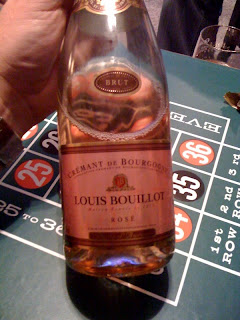
By the time we got to bubbly bottle 3 (there was some still wines mixed in somewhere), clarity of mind was touch-and-go, at best. However, we were eager to compare the crémant of Alsace versus the Louis Bouillot Crémant de Bourgogne (Burgundy) Brut Rosé. This one, likely Pinot Noir, Chardonnay, and (maybe) Aligoté was a full-on slap to the face. It smelled (confirmed by 3 others) exactly, I mean EXACTLY, like an old tent. As if you hadn't been camping in a while, and unfurled the tent and the sleeping bags in the garage. Sadly, although we were amused by the sheer familiarity of the scent, I'd have to say this one was clearly corked (learn more about that in this post). A shame, but at this point in the evening, I'm pretty sure it was consumed anyway...
...I say "pretty sure", because I vaguely recall curling up on the floor shortly after, dreaming hazy dreams of a prosperous 2010, and contemplating the unlikely prospect of those morning jumping jacks.
Happy New Year, everyone.
Thursday, December 31, 2009
Sparkling Wine Tips (in a language I can understand...cartoons)
It's the last post of the year, so I figured I'd blow it out with some cartoons and a showcase of my incredibly sub-par musical skills. Been thinking about doing more of this. If you want more, please oink. If not, hiss like a garden snake.
Whether oinkin' or hissin', I hope all of you have a very safe and Happy New Year! See you in 2010 (if I'm not killed by a flying cork)!
Oh, and Cheers, Sláinte, L'Chaim, Salud, Prost, Skål, Konbe, Kampai, and Laissez les bon temps rouler!
Wednesday, September 16, 2009
At The Source: Wine Blogging Wednesday #61 (aka "Georgia Wines, part 3 of 3, but now with a part 4 because I suck at brevity")
Been building up to this for a while; a little too difficult to condense my experiences of Georgia wine into one post (another big thanks to Lenn Thompson at Lenn Devours for putting together Wine Blogging Wednesdays and hosting #61!). And I know, I've come off as pandering. I get it. Talking about "beautiful grounds" and "great people" and "unforgettable experiences" in two previous posts: first about Montaluce Winery, then another about Wolf Mountain Vineyards, both on the Dahlonega Plateau in North Georgia. I've probably come off a sell-out advertiser for their businesses.
Well, lay off. I was born in Atlanta. I grew up in the 'burbs. I attended the University of Georgia. Then I moved back to Atlanta. Now I live in the 'burbs...
...crap. I forgot to attend the University of Georgia again somewhere in-between. Why does my life feel like a scene in Groundhog Day? Anyway, I guess my point is that I can't help but have an affinity for the natural beauty that does exist in my home state, especially up north. I won't be faulted because people in the hospitality industry are generally quite nice (especially folks I've met in the wine industry, and especially in the South). And I won't apologize for (even shamelessly) backing a wine industry if it helps Georgia's economy. We DID genuinely enjoy the grounds and the views. The folks HONESTLY came off as genuine and welcoming to my wife and I. Was it because they knew they'd get free publicity? Sure, that's possible, but I don't believe it's the case. For these reasons alone, visiting Georgia wine country is a good idea, even if you don't drink wine at all. But, despite my abhorrence of critiquing anything (I was once told- quite correctly, I think- that a critic is no more than bitter fool slamming something he's not good enough to do himself), I at least owe the wineries and the readers an honest opinion of what I drank. I'm not good enough to do what they do. I also suck at being critical. If anything, I offer fodder for you to provide an entertaining dissent.
We tried a LOT of wine...I think 15 total, including ones made from Chardonnay, Viognier, Sangiovese, Merlot, Cabernet Sauvignon, Mourvèdre, Touriga Nacional, and Syrah. Georgia's really still trying to figure out what works best with the climate. I also know of Riesling, Seyval Blanc, Vidal Blanc, Cabernet Franc, Pinot Grigio, Petit Verdot, and Malbec creeping up the trellises in the Peach State, so there's a lot going on.
Okay, okay, I know I'm filibustering. On to the wines, and I'll try to keep it as brief as possible:
2008 Blanc de Blancs Brut: French for "white from whites", this is a sparkling wine made from 100% Chardonnay. Wolf Mountain employs the "Méthode Champenoise", or tradional method of secondary fermentation in the bottle. This creates a yeasty, biscuity bubbly with smaller, longer lasting bubbles. This one was very lightly yeasty, with a nice herbal, melon, and citrus nose. Clean and herbal in the mouth. Frankly, one of my favorites...paid full price and took a bottle home with me.
2008 Plenitude: An unoaked, 75% Chardonnay, 25% Viognier blend (blending being a common theme in Wolf Mountain wines). Peachy, herbal nose, kiwi, cantaloupe. Nice acidity in the mouth, very clean, but a little hollow, like the flavors dropped off. Nothing complicated, but a fine easy-drinker.

2008 Chanteloup: Same blend as the Plenitude, but it spent 6 months in French Oak (I couldn't find out whether the oak was new, neutral, or in-between). I think the oak aging helped in this case. Where the Plenitude fell short, the structure and tannin of the oak kind of "filled in the gaps". It reminded me a lot of an Alsatian white: nice floral nose, really dry in the mouth, with a fuller mouthfeel. I really preferred this to the Plenitude
2008 Sunset Rosé: a Rhône-style blush wine of Mourvèdre and Syrah. It was really earthy and clean, once again subtle and simple. I noted that I wasn't sure if these wines were just VERY subtle, or if they were just lacking complexity. Regardless, I'd knock this back with some pulled pork any day. I just wouldn't pontificate about it. I guess, often, that's what rosé is about anyway: uncomplicated summer quaffing.
2006 Coupage: A right bank Bordeaux-style blend of 65% Merlot and 35% Cabernet Sauvignon. 40% of the grapes underwent a whole-berry fermentation, or "carbonic maceration", which you see a lot in Beaujolais. My wife really liked this one, so I'm sure it had its merit. To me, this was my least favorite. The nose was just kind of sickly, and I couldn't get past it. I'd like to give it another try, but it really wasn't doin' it for me on this day. That being said, I really respect the creative techniques in effort to make better wine.

Howling Wolf Red: A non-vintage blend of leftover 51% Syrah and 49% Cabernet (winemaker Karl Boegner referred to it as a "byproduct" wine). Well, it was a damn good byproduct, and probably my favorite of the day. A very earthy, minty, chocolate & berry nose led into a silky, smooth mouth of dark fruit. Nice, smooth and ripe tannins. However, the incredible earthiness in it (like many of the wines) really screamed "Georgia terroir" to me, in the best way possible. I drank this with my wife and a professional chef on Sunday. The chef, although half-in-the-bag, declared it to be "pretty damn good wine". That's a ringing endorsement. Nice effort.
2006 Claret: 70% Cabernet Sauvignon, 30% Mourvèdre. Nice berry, tobacco, and pepper nose. Once again, I wrote down "clean" in the mouth, suggesting it was a little hollow and lacking in complexity to me. Despite the grapes, the tannins were pretty smooth, so it was ready to drink.
2008 WMV Demi-Sec: an off-dry 75% Chardonnay/ 25% Viognier blend with 3% residual sugar. Nose of pineapple, melon...almost "Riesling-y" (can you just add a "y" to the end of anything and make up a stupid new word?) in the sense that there was a fuel-ish smell (okay, you can frivilously add "ish" as well). Banana-y (crap!) as well. The mouth had tropical fruit flavors: papaya and mango, but I think it lacked acidity. Not bad.
Okay, originally, I planned on talking about the Montaluce wines as well, but the length of this thing is getting ridiculous. I'll do that in a separate post. Until then, I've seen Wolf Mountain wines at Harry's/ Whole Foods, and Total Wine (check your local bottle shop too). Give them a try and compare notes. I welcome you to disagree with me, because that just proves how trivial wine reviews really are. It's all about personal taste, and mine is very likely different from yours. I'd like to think I've just given you some cliff notes. At the very least, I hope- once again- that you support the local growers and vintners.
And now, I will shut up. Okay, not yet: Cheers, Sláinte, L'Chaim, Salud, Prost, Skål, Konbe, and Kampai!
Monday, July 27, 2009
Sparkles with only a few Shekels
 With all due respect to the coup de gras of elementary school hangouts growing up in suburban Atlanta, this post has nothing to do with Sparkles Roller Rink, where I first crafted my lifelong mastery of being awkward and unattractive to the opposite sex (my re-imagination of the scene: "get a load of the guy with the matted hair and the sweatpants playing "Altered Beast" in the arcade...hot tamales!").
 Actually, I can't believe it's still around...lots of memories; none of them memorable.
But like I said, this isn't about my repressed sources of social anxiety. Today, we talk about sparkling wine, often- mistakenly- referred to as Champagne.
Sure, I know that came off as snobby. I assure you I'm about as snobby as the lonely kid playing video games in the corner of a roller rink while the pretty girls skate with that jerk Tommy Olsen, what with his new Members Only jacket and penchant for wedgies. But I just need to clear the air (apparently on many issues). Champagne is a region in France. Like most French wines (or most European wines, for that matter), wines are named for the region, not the grapes or style...it has something to do with their sacred concept of terrior (pronounced "tehr WAH"), but that's another post. Sparkling wine, however, is a catch-all term for the myriad styles of wine that simply have bubbles. How the bubbles get there, well, also another post. Looks like you're saddled to a gravy-train of content, coming to a poorly-thought-out blog soon! Bottom line: if it says "Champagne" on the bottle, but doesn't say "product of France" also, it ain't really Champagne. I guess it's the same as taking farm-raised Thailand shrimp and selling them as wild-caught U.S. gulf shrimp. Basically, it's lying for the purpose of marketing, so that may be why people get so "snobby" about it.
 However, sparkling wine is made in almost every wine region in the world. Furthermore, due to the overwhelming popularity of French Champagne, many of these regions are making great stuff, but aren't charging a lot as they try to get established in the consumers' minds. Yep, I smell bargains too. I decided to grab a few bottles from 3 major wine regions in the world: Spain, Italy, and Germany. I also decided- mainly because this is a labor of love- that I'd try to find bottles that were under $12. If you want to try them, I conceded to the big-boys and bought these at Total Wine. Without further ado, here they are, and here's what I thought:
 E. Soria Prosecco Spumante NV: For anyone new to wine out there, the "NV" stands for "non-vintage", meaning that this is a blend of wines from different years, which is pretty common in sparkling production. Anyway, this wine is from Italy, and it's made from the Prosecco grape. Generally known as a light, simple quaff, it's not meant to be complicated, and I found this one to fit that profile. Refreshing and not overwhelming at 11.5% ABV, I got pears, a little bit of apricot and other stone fruit on the nose (think peaches, nectarines), and some floral notes. It tasted of crisp, tart appless and more of that apricot. I was a little disappointed at how quickly it lost its fizz, but that's too be expected, as it's made in the charmat method, creating larger bubbles that- subsequently- take carbon dioxide out of the beverage more quickly. All-in-all, nothing special, but it's not meant to be. Just an easy-drinking warm weather cocktail that won't hurt your wallet.
 Segura Viudas Cava Brut Reserva NV: In my opinion, the best of the bunch (and, to my delight, the cheapest, at around $8). Cava, a term designating sparkling wines from Spain, really is a great bargain. Made from the Parrellada, Macebeo, Xarel-lo (and increasingly, Chardonnay) grapes, this wine brings serious value because it is made in the Método tradicional- or "traditional method"- meaning a secondary fermentation takes place in the bottle, creating the smaller bubbles naturally (and smaller bubbles stay "fizzy" longer!). Furthermore, the contact with the yeast during secondary creates tasty flavors of bread, biscuits, and toast. I got those slightly in the mouth, along with a mixed bag of tart apple and almonds. The nose suggested a heavy dose of Chardonnay in this blend, as I got apples, butter, and toast. It also delivered an 11.5% ABV, just enough to put some "hitch in your giddyup." Not an earth-shaker, but at $8-9, it's hard to beat. Try it with some raw oysters and live the good life on a "suburban wino" budget.
 Henkell Sekt "Trocken" NV: "Henkell" is the brand, "Sekt" is the term for sparkling wine in Germany, and "Trocken" simply means "dry". Tomorrow, we'll learn how to say "is this a snowball fight?"
This wine, like the other two- had 11.5% ABV. It was probably made in the charmat method like the Prosecco, and in the same way, it lost its fizz pretty quickly. At first, it didn't smell like anything, but when I came back later, I got some faint scents of stone fruit and a little bit of "biscuitiness", as my notes say. Actually, the nose was pretty similar to the Prosecco in my opinion (this isn't too surprising, as cheaper Sekts are often made with grapes from Italy or France). In the mouth, I wasn't too impressed. It tasted almost like cheap, alcoholic ginger ale...maybe Vernors? At $12, it was probably the worst for the money, but- quite frankly- I enjoyed it just fine as the night went on. Like the prosecco, it was uncomplicated and ended up being enjoyable. Perhaps it was just a little disappointing after the fuller flavors of the Spanish Cava. Hey, it was a lot better than Cook's.
Whether I liked them all or hated them all, I hope you give all of these wines a try. Not only will you be experiencing a whole new world of sparklers, but you'll also be trying something you maybe haven't tried before. To me, that's what's so addictive about wine....hundreds down, millions still to try. Just don't try them all at once.
Oh, and if you're a pretty girl at the roller rink, and you see the nerdy kid in the sweatpants playing video games, go grab him and get him out on the rink. Who knows: he may grow up to be a lowly-paid wine writer someday. Actually, you probably shouldn't be reading a blog about alcohol in that case. How'd you find this site?!
Anyway- until next time, Cheers, Sláinte, Salud, Prost, Skål, Konbe, and Kampai!
Subscribe to:
Posts (Atom)


